Wednesday, October 19, 2022

Conflicts of Interest

Seeking a remedy for abuse by pursuing litigation is like being stripped naked before the enemy, with the presumption that the accused is innocent and the injured victim is not to be believed without proof. This violation of the victim's privacy is made worse by defamatory claims made by the offender with impunity. It adds significant injury in a biased justice system that is anything but fair or accessible.

Open court is a venerated ideal of justice in common law systems, and a principle that is regarded as indispensable. Generally, the principle requires that court proceedings be open to the public, and that publicity as to those proceedings be uninhibitedhttps://www.justice.gc.ca/eng/rp-pr/cj-jp/victim/rr03_vic1/p4.html

When I asked permission to install HVAC to accommodate the lung diseases of my husband and myself NW2671's bylaws specifically contemplated enabling installation of HVAC. Council members in 2019 made motions to "allow it" with conditions, such as "the criteria should be as close to middle of the road in price and warranty as possible."

In my attempts to facilitate timely installation I voluntarily offered to pay the expense and sign an agreement for future maintenance if council required it, but it did not request payment nor indemnification. When I asked if anything else was required, council did not ask me to provide anything at all, even though I asked repeatedly. 

NW2671 was already aware of my COPD and had been ever since it installed a vent in our bedroom in 2005. I nevertheless decided to provide further evidence of the medical conditions of my husband and myself, but that was a big mistake. Council immediately violated our privacy in contravention of PIPA and shared our confidential medical information with the most hostile imagainable neighbour, and after I complained gave me the most unspeakable traumatic shock by appointing her as a representative for mediation instead of a council member, knowing full well that she attacked us on multiple levels for years, that I would be extremely upset, and that she does not negotiate as already proven in CRT proceedings. 

Appointing this hostile neighbour who previously deprived us of gate access and strata records for years, vandalized our home by destroying surrounding shade trees, and made false accusations to the RCMP that I was trespassing and abusing animals to intimidate me out of continuing a sit down protest against significantly unfair exclusive use of common property for unlawfully added skylights and extra decks by council members acting in conflict in contravention of proportionate unit entitlement, s.76 of the SPA, and Use of Property bylaws was such a shocking betrayal after I had exhausted all other timely resources available to me that I bought a rifle within 30 minutes.


The property manager denied my HVAC request for no good reason without council having a meeting, much less a majority vote

Instead of acting reasonably, council doubled down and subjected us to years of litigation stress, discriminatory harassment, and personal endangerment for no good reason. During this time it repeatedly violated the terms of mediation without penalty by publishing defamatory reports that I cannot defend against without violating an offensive nondisclosure contract that I agreed to honour.

Adding insult to injury, council acted persistentlyfor 3 years trying to amend the bylaws to prohibit HVAC installation by not allowing the required penetration of the building envelope, not allowing heat pumps anywhere shown on the strata plan, and mandating that owners asking to install HVAC waive their statutory rights and protections in contravention of the Strata Property Act (the "SPA") and standard Use of Property bylaws. 

The owners rejected council's motions, which were all contrary to past practice where the strata built dozens of extra decks and perpetually repairs, maintains, and insures added skylights, gas lines, and garages as common property in accordance with s.72 and s.149 of the SPA for the exclusive use and enjoyment of more privileged owners without disabilities.

If my HVAC request or council's responding motions to "allow it with conditions" and "the criteria should be as close to middle of the road in price and warranty as possible." were voted on by council in 2019 as required by s.4 of the SPA and recorded in the minutes as required by s.35 toxic litigation could have, and probably would have, been avoided. 

If Councillor McConnell's motion to delete the obstructive location restriction was not ignored and the wording voted on and recorded in the minutes was not further tampered with and changed when registering the bylaw in the Land Title Office we might not have been so thoroughly discriminated against. 

So how could this happen? 

I think it happened because NW2671 is not managed by the owners or the strata council. 

Council members serve at the pleasure of the property manager and routinely approve her declarations because Rita Caulien Brown, who owns nothing and pays nothing, performs the duties of president, secretary, treasurer, and council, controlling in large part, if not completely, the strata's meetings, correspondence, agenda, minutes, budget, purse strings, other agents, and hiring decisions, so council doesn't know what's going on. It became obvious that council has no idea what's going on even in litigation, particularly when Rita was the only observer. This transfer of so much power into the hands of a single person is an inherent conflict of interest, but it is becoming standard practice throughout BC's strata agency industry

NW2671 is managed by a professional strata agent who has the ability to be quite charming and very persuasive, but she is not subject to the SPA. She contravenes it routinely, and in that regard she can be sarcastic, disrespectful, and vindictive. She retaliates against me relentlessly for complaining about the harm she is inflicting on us by tampering with strata records, withholding them in contravention of s.36 of the SPA, and destroying incriminating evidence. 

I don't blame the owners who had the good sense to reject prohibitive bylaw amendments for 3 years. I don't blame them for being coerced by killer heat and Rita's advice that adopting new bylaws would allow us to install HVAC (in unlawful ways, and the most intrusive, obstructive, and inappropriate imaginable heat pump locations for no good reason.) I don't even blame members of the strata council who have no idea of the law and are just trying to live their own lives. I do blame Rita Caulien Brown aka Vanidour, but she could not act as she does without the support of the industry.

Members of the strata council acting in conflict for their own unjust enrichment, contrary to the best insterests of the strata corporation are not volunteers making innocent mistakes. Those taking common property for their own exclusive use and enjoyment contrary to proportionate unit entitlement and short term use restrictions, imposing special levies on others because they are not imposing s.6.9 User Fees on themselves for decades, routinely dominate council to profit from their own wrongs at the expense of their neighbours. BC's strata industry exploits this situation by seizing every opporltunity to transfer power and control from council members, who are subject to the SPA, to property managers, who are not. These "strata managers" holding themselves out as the "strata council" can, and do, contravene the SPA routinely at the expense of law-abiding owners. This contributes to churning up conflict, manufacturing confusion, and depriving owners of the accurate factual data that they require to make reasonably informed decisiions, keeping everyone at their mercy in invisible prisons of ignorance.

It is not just corrupt council members and the highly organized Strata Property Agents of BC who are at the root of most problems "in this multi-billion dollar industry in BC." 


The strata industry includes the associations that are held out to represent owners of strata property. CHOA, for example, is admittedly "the largest association REPRESENTING THE STRATA INDUSTRY in British Columbia" (my emphasis added.) When there is a conflict contrary to the best interests of condominium home owners and BC's multi-billion dollar strata industrythese associations represent their partners in industry, not home owners.


BC's strata industry also includes the legal profession, acting contrary to the law. For example, in deferrence to the strata Kate Campbell, Vice Chair of the CRT, contravened the Limitation Act, Interpretation Act, and the tribunal's jurisidiction, unfairly depriving me of equal protection under the law contrary to s.76 of the SPA and standard Use of Property bylaw prohibititions in Bond v. NW2671. 

Clark Wilson offered to sell a booklet advising stratas to delete email and then claimed that its legal advice to those consumers who paid good money for it is not legal advice. In the same way it published an insurance flow chart advising consumers that "owners arrange and pay for repairs to all damage to their strata lot regardless of the cause of damage" if it is below the strata's deductible. Those are just some examples I have proof of.


Clark Wilson's flow chart is published by CHOA despite the fact that its persistently deceptive advice is inconsistent with Part 9 of the SPA, and in particular 
s.158, which states in perfectly plain language that:

"158   (1) Subject to the regulations, the payment of an insurance deductible in respect of a claim on the strata corporation's insurance is a common expense to be contributed to by means of strata fees calculated in accordance with section 99 (2) or 100 (1)."

An owner (who is a named insured pursuant to s.155) makes a claim on the strata corporation's insurance  when they report damage from the occurrence of a major peril, , which is usually water escape, and request compensation. If the loss is not reported within a prescribed time limit the policy is breached and benefits that the insured might be otherwise claim could be voided.

Clark Wilson is conflating a claim by an insured for compensation for damage from the occurrence of a major peril with a payment made by the insurer depending on whether its investigation reveals that the damage exceeds the deductible.  

Clark Wilson is also conflating  with the owner's responsibility for upgrades and routine maintenance with the strata's statutory responsibility for the insurance deductible and full replacement value repairs of damage from the occurrence of a major peril. 

With all due respect, "claim" and "deductible" are different words, as are "report" "payment" and "repair." They each have their own meaning in statutory interpretation as well as in plain language. 

Shockingly, BC's multi-billion dollar strata industry includes the Insurance Council of BC heading up a strata insurance conspiracy that is manufacturing multiple premiums on the same property and multiple deductibles on the same event by deceptively advising consumers that "strata insurance is for common property only" Strata Insurance Policies (insurancecouncilofbc.com

Such a blatant falsehood coming from the regulatory body appointed by the BC provincial government is contributing to derelict stratas contrary to Part 9 of the SPA, and s.149 in particular, which states in plain language what strata insurance is for, as follows: 

“149   (1) The strata corporation must obtain and maintain property insurance on

(a) common property,

(b) common assets,

(c) buildings shown on the strata plan, and

(d) fixtures built or installed on a strata lot, if the fixtures are built or installed by the owner developer as part of the original construction on the strata lot.

(2) For the purposes of subsection (1) (d) and section 152 (b), "fixtures" has the meaning set out in the regulations.

(3) Subsection (1) (d) does not apply to a bare land strata plan.

(4) The property insurance must

(a) be on the basis of full replacement value except in prescribed circumstances, if any, and 

(b) insure against major perils, as set out in the regulations, and any other perils specified in the bylaws.”

All strata lots, even those built in air space, are "buildings shown on the strata plan," and "fixtures built or installed on a strata lot"  and "major perils" are defined in Part 9 of Strata Property Regulation ("SPR") as:

9.1   (1) For the purposes of sections 149 (1) (d) and 152 (b) of the Act, "fixtures" means items attached to a building, including floor and wall coverings and electrical and plumbing fixtures, but does not include, if they can be removed without damage to the building, refrigerators, stoves, dishwashers, microwaves, washers, dryers or other items.

(2) For the purposes of section 149 (4) (b) of the Act, "major perils" means the perils of fire, lightning, smoke, windstorm, hail, explosion, water escape, strikes, riots or civil commotion, impact by aircraft and vehicles, vandalism and malicious acts.


I have lived in stratas since 1984, and after nearly 40 years of observation, education, communication, and exhausting every available resource to correct obvious and persistently continuing contraventions of governing enactments I have concluded that most, if not all, strata strife flows down from the top levels of political governance, and that is what is preventing access to justice.

I have published only a few examples of systemic patterns that are contributing more than they are worth to a dysfunctional society on a continual basis. This is killing law-abiding tax payers while the manufacturers enjoy immunity, not unlike lung cancer from smoking, it's a very costly social experiment. It is incredibly wasteful of human resources also.

BC's strata industry includes the construction industry, which has been profitting enormously from its own wrongs at the expense of owners of strata property for decades - while building codes continue to perpetuate catastrophic losses, not the least of which is when a toilet overflows in a high rise, or when vulnerable seniors die in killer heat, choking smoke, or virus laden air in substandard ventilation. 

It cost my husband and I close to $100,000 in 2005 dollars for a leaky condo project that left NW2671 devastated from 2004 to 2010 and beyond. Leaky condo crisis - Wikipedia


Since the mid 2000s NW2671 has been perpetually impoverished with diminution of property values and market stigma from significantly unfair methods of operating, patterns of inequality, continuing contraventiions, ongoing litigation issues, destruction of landscaping, geotechnical instability, routine special levies, sky high strata fees and insurance costs, and restricting sales to less than prudent purchasers with confusing, contradictory, unenforceable bylaws, made worse with unreasonable AOLs while council after council fails to take corrective action.

The strata agents of BC are profiting from add-on fees for everything from refusing to post strata records online for owners to have free access 24/7 to witness fees or administration charges for anything or everything; the real estate industry is profittting from provoked sales; the legal profession is profiting from churning up make-work disputes and litigation; the construction industry is profiting from churning out defective buildings and defective depreciation reports; the insurance industry is profitting from charging sky-high premiums multiple times on the same property and insane deductibles multiple times on the same event; the condominium home owners associations are profitting by memberships and other fees, partnership agreements, and a whole lot of power, while trusting owners of strata property lose their homes or are bled dry in BC's strata industry.

Labels: , , , , , , , , , , , , ,

Sunday, October 4, 2020

Protect the public from chicanery

Membership in the BC Law Society does not authorize lawyers to pervert the law or usurp binding legislation, but in practice that is exactly what strata lawyers are doing, injuring or endangering the public and bringing the administration of justice into disrepute to churn up profitable strife. 

With respect to the truth, the whole truth, and nothing but the truth, the quote from Veronica Franco of Clark Wilson, which I set out below is an excerpt from her anything but innocent perversions of s.72 repairs and s.149 insurance that deceptively suppress or keep back material sections of the SPA. 

Where there is no insurance coverage, the duty to repair a strata lot falls to the strata lot owner, subject only to any bylaws that make the strata corporation responsible for the repair and maintenance of portions of a strata lot. In practice, this means that strata corporations with section 8 of the Standard Bylaws to the Act are responsible for stopping the leak, drying the structure (i.e. the wood joists and framing within the walls). Once those initial emergency repairs are completed, then the owner is responsible for any damage to the walls, floors and ceilings damaged by the water. CW8090699.1

The truth is, s.149 provides "no insurance coverage" for routine s.72 repairs and maintence, but that is totally irrelevant to damage from water escape. INSURANCE COVERAGE for major perils, such as water escape, is mandatory at full replacement value under s.149. So contrary to what Ms. Franco claims, the strata is not only responsible for stopping the leak and drying the structure, it is also responsible for providing repairs of the building as a common expense under s.158 until the deductible amount is reached pursuant to s.149 and Regulation 9.1, including fixtures attached to the building, such as floor and wall coverings and electrical and plumbing fixtures in the strata lot as built.   

"In practice" Ms. Franco deceives readers, contrary to the benefit of owners, and perverts s.149 and the whole of Part 9 Insurance in the SPA. Contrary to Ms. Franco's claims, the owner is NOT responsible for the walls, floors, and ceilings damaged by the water, unless the strata can prove to a court that the owner was responsible for the loss, and standard bylaws, which refer to routine repairs and maintenance are irrelevant in regard to damage from water escape. In addition, pursuant to s.121, any other bylaws are unenforceable to the extent that they conflict with the SPA.  

I use the word fraudulent in the context set out by the Supreme Court of Canada in Redican v. Nesbitt, [1924] SCR 135, 1923 CanLII 10 (SCC), where a false statement is fraudulent when made knowing it was false, or recklessly, careless whether it were true of false with intent it shall be acted upon in one's own interest. 

Clark Wilson has a habit of giving fraudulent legal advice to stratas in everything from disclosure of strata records to insurance and repair obligations, and Ms. Franco should be fired and barred from such unauthorized practice of law. The chicanery she practices was unfortunately adopted by CRT tribunal members when they had not yet developed any special expertise in strata matters. 

After 4 years experience, it is time for the CRT to stop being led down this dangerous path by those acting in violation of the SPA in conflicts of interest contrary to the benefit of owners of strata property.  Owners of strata property have to be able to rely on the law, and to do so, the CRT has to fire tribunal members such as Kate Campbell, who was hired with no special expertise in strata law, and acts in arrogant disregard. Some people are unteachable, but some are morally reprehensible. 

At this point in time, critical analysis of legal opinions and court or tribunal decisions is required to identify fraudulent ommissions or deliberate arrangements of order that confuse and mislead most readers. Such betrayal of trust is the antithesis to resolving disputes justly or affecting positive social change in strata life.

UNFORTUNATELY, I forgot to include the part above in the part below, which makes it difficult to make sense of my message. This KIND OF MISTAKE is a hallmark of the PTSD that impairs my ability to function efficiently and effectively enough to organize the evidence required to defend myself and others from oppression. I don't let it stop me though. I just keep on doing the best I can to help for whatever it's worth. 


From: dianne.bond@yahoo.ca <dianne.bond@yahoo.ca>
To: Veronica Franco <vpf@cwilson.com>

Cc: Choa Bc Support <info@choa.bc.ca>; Canadian Condominium Institute CCI - Vancouver Chapter <socialmedia@ccivancouver.ca>; Visoa Bc Administrator <administrator@visoa.bc.ca>; Kevin Zakreski <kzakreski@bcli.org>
Sent: Monday, August 31, 2020, 10:00:26 a.m. PDT

Subject: Chicanery

FYI I have posted the following information online. 

People keep asking me about strata insurance...

Veronica Franco from Clark Wilson wrote to our property management company in a letter dated March 25, 2015, saying that,

"Section 149(1) of the Act sets out the duty to insure. In addition to the common property, a strata corporation has a duty to insure the buildings shown in the strata plan. This would include such things as the walls and ceilings even though the walls and ceilings are part of the strata lot. Similarly, a strata corporation must insure fixtures built or installed in a strata lot if they were installed by the owner developer as part of the original construction of the strata lot. This requirement to insure fixtures exists even though most of these fixtures (i.e. kitchen cabinetry and flooring) are part of the strata lot. In short, this means that the strata corporation is required to insure under section 149(1) many items beyond that which it is required to repair and maintain under section 72 of the Act."

HOWEVER, the owner is responsible for any difference between original fixtures and upgrades, and if the the strata can prove that the owner is responsible for the cause of the damage, the strata can sue to recover the deductible under s.158(2).

Section 72 of the SPA applies to uninsured damage, such as damage to owner upgrades to the original fixtures, or damage from perils that are not insured under the strata policy, such as routine maintenance or deliberate arson or vandalism by an owner, not the deductible amount that's self-insured by the strata. Nothing in s.72 takes precedence over, or conflicts with, Part 9 of the SPA.

The end result is that where there is s.149(4)(b) damage from an insured peril, such as water escape defined under Reg.9.1(2), the strata pays the deductible amount as a self insured common expense under s.158(1).

If the damage exceeds the deductible amount, then the strata corporation's insurer pays for everything above the deductible except for upgrades. Either way, damage from insured perils is covered at full replacement value under s.149(4)(a), it is not discounted by the deductible or bylaws in any way. Under s.121 bylaws are enforceable to the extent they conflict with the SPA.

Whether the cost of repairs is paid by the insurance company or the strata out of the CRF or special levy under s.158(3), the funds are held in trust either way, and under s.159(a) any decision not to repair or replace requires a resolution passed by a 3/4 vote at an annual or special general meeting, and s.35 requires that the decision be recorded in the minutes.

Case law that suggests otherwise is distinguishable on the basis that one or more material sections of the SPA were not considered, or were taken out of context. Check it out.

I am a retired paralegal, not a lawyer, but anyone who "Likes" this information and wants to share it with their lawyer, strata council, property manager, adjudicator, or other owners has my permission

I hate to be unfair or misleading, so please correct me if you perceive anything I've said to be anything other than the truth and nothing but the truth, and I will take corrective action to address any such concerns. The "whole" truth is another issue in regard to what appears to be expertly crafted deception by Ms. Franco and CHOA, which I refrained from mentioning in this post, but I am mentioning now and in this regard bring your attention to the following cite: 

Fraud may consist as well in the suppression of what is true as in the representation of what is false. If a man professing to answer a question, select those facts only which are likely to give a credit to the person of whom he speaks, and keep back the rest, he is a more artful knave than he who tells a direct falsehood. Heath, J., Tapp v. Lee (1803), 3 Bos. & Pull, 371; Park, J., Foster v. Charles (1830), 4 M. & P. 70.


Labels: , ,

Saturday, December 2, 2017

Strata Insurance


The Strata Property Act requires the strata corporation to provide insurance as follows.

Property insurance required for strata corporation
149 (1) The strata corporation must obtain and maintain property insurance on (a) common property, (b) common assets, (c) buildings shown on the strata plan, and (d) fixtures built or installed on a strata lot, if the fixtures are built or installed by the owner developer as part of the original construction on the strata lot.
(4) The property insurance must (a) be on the basis of full replacement value, and (b) insure against major perils, as set out in the regulations, and any other perils specified in the bylaws.
 Liability insurance required for strata corporation
150 (1) The strata corporation must obtain and maintain liability insurance to insure the strata corporation against liability for property damage and bodily injury.
(2) The insurance must be of at least the amount required in the regulations.
Errors and omissions insurance
151 The strata corporation may obtain and maintain errors and omissions insurance for council members against their liability and expenses for errors and omissions made in the exercise of their powers and performance of their duties as council members.
Named insureds
155 Despite the terms of the insurance policy, named insureds in a strata corporation’s insurance policy include (a) the strata corporation, (b) the owners and tenants from time to time of the strata lots shown on the strata plan, and (c) the persons who normally occupy the strata lots.
Application of insurance money
157 Insurance money received under section 156 with respect to damaged property must be used to repair or replace the damaged property without delay unless the strata corporation decides not to make the repair or replacement under section 159. 
Insurance deductible
158 (1) Subject to the regulations, the payment of an insurance deductible in respect of a claim on the strata corporation’s insurance is a common expense to be contributed to by means of strata fees calculated in accordance with section 99 (2) or 100 (1).
(2) Subsection (1) does not limit the capacity of the strata corporation to sue an owner in order to recover the deductible portion of an insurance claim if the owner is responsible for the loss or damage that gave rise to the claim.(3) Despite any other section of this Act or the regulations, strata corporation approval is not required for a special levy or for an expenditure from the contingency reserve fund to cover an insurance deductible required to be paid by the strata corporation to repair or replace damaged property, unless the strata corporation has decided not to repair or replace under section 159.
Decision not to repair or replace
159 (1) The strata corporation may, by a resolution passed by a 3/4 vote at an annual or special general meeting held no later than 60 days after the receipt of the money referred to in section 156, decide not to repair or replace the damaged property. 
(2) Subject to section 160, if the strata corporation decides not to repair or replace the damaged property, the insurance trustee or the strata corporation that receives the payment under subsection (1) of this section holds the money and any interest on the money in trust for each person who has an interest in the money, including the holder of a registered charge, and
(a) must distribute the money according to each person’s interest, or
(b) if an application is made under section 160, must distribute the money in accordance with the order made under that section.
***************** 

https://www.investopedia.com/terms/i/insurance.asp
insurance is a contract, represented by a policy; pools risks to make payments more affordable; used to hedge against risk of losses that may result from damage or liability for injury (eg."all in it together" strata policy & deductible, replacement value -db)

http://www.bclaws.ca/civix/document/id/complete/statreg/98043_09
the SPA governs s149 water damage repair, s155 named insureds include owners despite terms of strata's policy, s156 insurance proceeds are paid to strata in TRUST until paid under s157, strata pays s158 deductible, or sues if it can prove owner is responsible (strata insurance seems like a trust -db)

https://www.valuepenguin.com/choosing-homeowners-insurance-deductible
a deductible is the amount of money a policyholder must pay out-of-pocket toward damages or a loss before their insurance company will pay for a claim  (s.158 strata pays deductible per s.99 strata fees, otherwise strata must sue to prove an owner is responsible to pay -db)

***************** 

This whole article is worth posting, with added emphasis (and comment) 
Choosing The Right Homeowners Insurance Deductible
Choosing the right deductible is vital to getting the most out of your homeowners insurance policy. Every policy has a deductible so every person buying homeowners insurance will have to make this decision. The guide below will help you understand your deductible and calculate what yours should be.
Homeowners Insurance Deductibles
A deductible is the amount of money a policyholder must pay out-of-pocket toward damages or a loss before their insurance company will pay for a claim.(NOTE: the STRATA corporation is the POLICY HOLDER, and the deductible amount is a S.158 COMMON EXPENSE to be paid by s.99 strata fees) You do not actually pay your deductible to your insurance company like you would a premium or bill. If you file a claim and it is covered, the deductible is subtracted from the amount claimed. For example, say you have a $500 deductible and you file a claim for $10,000. Your insurance company would pay you $9,500 for that claim.
There are generally two types of deductibles: a dollar-amount and a percentage based. The difference between them is how your deductible is calculated, and there are a couple of nuances depending on how much your home is valued at. Once calculated, the amount a homeowner pays if they file a claim is fixed for the length of that policy.
Bottom of Form
How to Choose a Deductible for Your Policy
Your home insurance deductible should be as high as you can reasonably afford because the higher your deductible, the lower the cost of your premium. Raising your deductible can reduce the cost of your homeowners insurance premium as much as 20%, but that does not mean you should raise your deductible as high as possible.
When choosing a deductible, what you’re really doing is balancing the short-term cost you can afford (your deductible) and the long-term cost of a policy (your premiums). (NOTE: balancing risks and costs is fine, but OFFLOADING them onto an owner WITHOUT SUING TO PROVE RESPONSIBILITY is unlawful. Due process is explicitly required under the SPA.) The more you can afford in the short-term, the more you’ll save in the long-term because your premiums will be lower. Insurance companies design the products this way to encourage homeowners to assume more of their own risk and to reduce administrative costs for small claims. For example, the premiums would be higher for a policy that has a $500 deductible versus a $1,000 deductible because the policyholder elected to assume greater financial risk. They would have to pay $1,000 toward a claim instead of $500 if they had to file one.
There are other reasons it makes sense to raise your deductible. Every insurance company is different but typically if you file a claim for any amount, the cost of your premium will increase because you've essentially become a riskier and costlier homeowner to insure. And the more claims you file, the higher your premium will be. For that reason, there are circumstances in which even if you have a low deductible, it might not be in your best financial interest to file a claim.
For example, say you have a $500 home insurance deductible. If wind destroys a small part of your roof and causes $1,000 in damages, you probably shouldn’t file a claim if you can afford to pay for the damages out-of-pocket. Yes, you could have your insurance company cover the $500 after your deductible but the cost of your premium might increase. That increase might be small or large, depending on the amount claimed and especially the number of claims you’ve made. If you file multiple claims, the cost of your premiums could go up as much as 25% or more and you never know what what the future holds. After the small wind damage, hail could destroy your roof entirely and a tornado could damage your home a month later. All of a sudden you haven’t made it through the spring of one calendar year and you’ve already filed three claims. So if you’re in a financial position to consider paying for small damages or losses out-of-pocket, then you should increase your deductible and lower your monthly premiums. (NOTE: so if the STRATA CORPORATION POLICY HOLDER is in a position to pay small amounts it can increase ITS OWN deductible, but owners should not be PAYING PREMIUMS TWICE to cover the DEDUCTIBLE on major perils with FULL replacement coverage mandated by statute) If you remain claim-free for usually three years, companies can lower your premium rate.
Keep in mind that many insurance companies offer a one-time discount to customers who have never filed a home insurance claim. The discount might lower the cost of a standard policy anywhere from 5 to 20% depending on the company. If you file a claim and negate that discount, the cost of your premium will increase.
You should also keep in mind your emergency or available funds with an eye toward paying your deductible. While raising it can drop your rates, it should not do so at the cost of financial stress. (NOTE: increasing the amount of the deductible does not reduce the strata's STATUTORY OBLIGATION TO PROVIDE REPLACEMENT VALUE REPAIR COVERAGE FOR MAJOR PERILS) Everyone should have a liquid emergency fund in the event of unpredictable circumstances. A homeowners insurance deductible might be one of those so consider what you you have saved for an emergency when choosing your deductible. (NOTE: increasing the amount of the deductible means considering the strata's CONTINGENCY RESERVE FUND, not arbitrarily OFFLOADING corresponding costs onto some poor victimized owner) At the same time, it’s not a good idea for your deductible to entirely wipe out the savings you’ve set aside for an emergency. You might need additional emergency funds at the time you have to file a homeowners insurance claim. For example, say a fire or tornado destroys half of your home and it is uninhabitable. Most homeowners policies also offer additional living expense coverage to take care of hotels bills, restaurant meals and other expenses. But what if you reach your limits for those expenses or need money for another emergency? If your deductible consumes your entire emergency savings, you might not have the money to cover those expenses.
How Your Deductibles Impact Your Home Insurance Rates
Below are some examples of the impact a deductible will have on a premium. We calculated the changes to a premium for a sample policy from State Farm assuming several different deductible scenarios, which is the company with the largest share of the homeowners insurance market. Our example homeowner is insuring his dwelling for $200,000, personal content for $150,000, and general liability of $100,000.
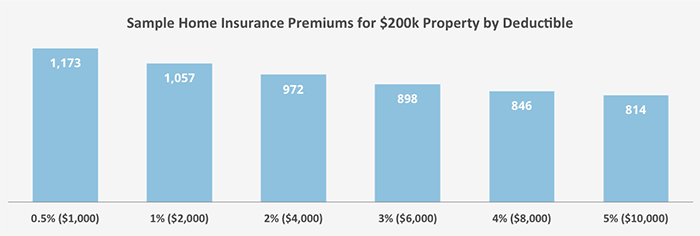
This graph shows how increasing the deductible can lower your homeowners insurance rates
You can see that raising your deductible has a substantial impact on the cost of your annual premium. (NOTE: I don't know what's wrong with this picture. We are paying so much more than anything shown in the chart that there is no comparison. In 2014 we paid about $675 of our strata fees for insurance premiums, with a $15,000 DEDUCTIBLE for water damage, when Unit 409's tax assessed BUILDING VALUE was $104,000. NW2671's December 31, 2017 balance sheet shows $16,724.84 in prepaid insurance, which the policy shows is to May 1, 2018. The strata's Income and Expense Comparative Statement shows the budget for insurance on 17 buildings was $58,714 for 2016 and $56,000 for 2017. This reduction reflects the reduced value of steadily DEPRECIATING buildings, For example, the premium for a sample policy covering the replacement cost of a $200,000 home with a 0.5% (effectively a $1,000 deductible) would be $1,173. The exact same coverage with a 1% / $2,000 deductible for our profiled homeowner would have an annual premium of $1,057 and a deductible of 5% on the house (which would equate to $10,000) would lower the premium all the way to $814. Based on our policyholder, doubling your deductible from 0.5% to 1% (that's from $1,000 - $2,000) could drop your annual homeowners insurance premium down by 10%. Each incremental 1% point increase thereafter in deductible reduces your rates about 4 - 8%. For this homeowner, increasing their deductible sixfold (from a 0.5% / $1,000 to 3% / $6,000) resulted in a 23% lower premium.


*****************  

"Strata Corporation Deductibles in Practice"

In Strata Corp. VR 2673 v. Comissiona, 2000 BCSC 1240, the court held that the right to sue is determined by the strata corporation bylaws...
Churning out continual strata strife in an inherent conflict of interest, lawyers are in my opinion instrumental in developing strata industry standards that conflict with the SPA. Introducing, for example, the notion that the strata can "download” the deductible to the unit owner contrary to s.158(1) by means of a bylaw that would avoid due process and the requisite burden of proof to effectively defeat the SPA, as well as oust the jurisdiction of the court contrary to s.158(2) and the principle of innocent until proven guilty.

In Mari v. OSP LMS 2835, 2007 BCSC 740, the BC Supreme Court judicially defined responsibility as distinguished from negligence. The court held that when the strata proved that the owner of the unit from which water escaped was responsible for the damage, the strata could then recover its deductible from the owner even if the owner was not negligent...
From my perspective there are 2 ways of looking at insurance deductibles. 
The SPA way treats major perils named in the policy as insured for full replacement value in all cases, with the deductible amount a common expense paid by s.99 strata fees. Filing a Proof of Loss by the strata or owner under s.155 for evaluation by the strata corporation's insurance adjuster and suing to prove an owner is responsible may be discretionary, but responsibility for replacement value repairs is not. 

The other way is to treat the deductible portion as uninsured. This approach contradicts the SPA's mandatory requirement to provide "full replacement value insurance against major perils" as set out in the regulations, and any other perils specified in the bylaws. It encourages excessively high deductible amounts, induces strata corporations not to file a proof of loss or commence a claim for recovery on the strata corporation's all risk property policy within the requisite one year period following the occurrence of the loss, leaves damaged property unrepaired contrary to s.159, and attempts to offload insured risks onto individual owners contrary to the "all in it together" principle and the due process of law. 
All of which is great for churning up legal disputes, but terrible for proper repairs and living in peace.

 *****************


A 3-bedroom unit pays about 30% more of the strata corporation's insurance expense, indeed of all expenses, than a 2-bedroom unit.

Even though a strata corporation’s insurance policy includes the owners as named insureds by law, and it seems like a waste of money for an owner to pay insurance premiums and then not file a claim when there is damage, I found a rather interesting link explaining this issue at http://completechoiceinsurance.com/7-times-you-shouldnt-file-an-insurance-claim.

I have summarized it as follows:
Filing a lot of claims is almost certain to cost more in higher premiums over time than you will get from claim settlements. Insurance companies report claims to industry wide databases, so all of the companies can see your claim history. They set your rates based not only on their assessment of your risk of having property damage, but also for the risk to them that you will file a claim.
As a result, there are situations where you are better off not filing a claim. For example, if the policy has a deductible of $1,000 and the total damage is $900, then the insurance company won’t pay anything, and premiums could still go up. There is not much point in going through the hassle of filing a claim, getting the damage appraised by an insurance adjuster, and risking higher insurance premiums if it is likely that the damage is below the deductible and you won’t get a payout anyway.
Even if your claim would be more than the deductible and you would get a payout, if you have filed other recent claims, you are risking a significant increase in rates by filing another one. The average person files a claim about once every eight to 10 years, so if you file claims more frequently than average, you could be setting yourself up for higher rates.
If a police report is filed, your insurance company will likely find out about the incident whether you report it or not. One of the benefits of getting your insurance company involved is to handle a potentially expensive lawsuit. Even if your incident is minor, you may want to talk with your insurance company if you get the feeling that the other party may pursue a liability claim.
If the damage is a few thousand dollars or less, you might still come out ahead by paying out of pocket rather than filing a claim. You can avoid the risk of higher premiums for years and getting a record that can follow you even if you look for insurance from a different provider.
Dog bites, water damage, and slip-and-fall claims are most likely to trigger rate increases on your homeowners insurance, according to Bankrate. Some insurance agents are obligated to report inquiries to the insurance company, and a mere inquiry about your coverage can be used to raise your rates due to the increased risk that you may file a claim. You can also ask your agent if they are obligated to report the inquiry to the insurance company before you start talking about a potential claim.
I can understand the strata having discretion to set the deductible, because no matter what the amount, it is a common expense. I can also understand the strata having discretion not to file an insurance claim for damage when it is unreasonable to do so, because replacement value repairs are mandatory in any event. 

I have a huge problem, however, when stratas set perversely high deductibles or purposefully avoid getting the damage appraised by an insurance adjuster in order to defeat their statutory obligation to provide replacement value repairs, and instead leave strata lots with unrepaired damage, especially when the strata or neighbours are responsible for that damage.

Our strata paid about $25,000 for replacement value repairs for 2003 water damage from a broken toilet that was self contained within a single lower unit and the responsibility of the owners themselves.  

Damage confined to one unit is by necessity less extensive than the damage a few days earlier to two units, when water escaping from a broken toilet in the upper level Unit 510 flooded both the source unit and our Unit 409 below when nobody was home in either unit to turn off the water. 

The owner responsible for the toilet tank in Unit 510 was in charge of negotiating insurance for the strata at the time. The deductible was $1,000 in the notice given for the AGM held within 2 months of the December 31, 2002 fiscal year end and $5,000 in the notice given for the AGM held within 2 months of the December 31, 2003 fiscal year end. I could not obtain a signed and dated copy of a policy actually in force at the time of loss. 

In any case, the mandatory insurance required for major perils specifically includes full replacement value repairs for water damage, and as of 2018, the continuously incomplete repairs to Unit 409 are anything but full replacement value:
The strata lulled me into believing that the repairs to 409 would be completed and did not give me access to the insurance policy or advise me of my right to make a claim on the policy. It further prevented me from making a claim by starting to make repairs, which it then delayed until the time for a claim expired, leaving them incomplete.


The required vote for leaving damage unrepaired was not obtained since insurance money was not received because an unidentified member of the strata management team decided not to make the claim or complete the repairs.

I made extraordinary efforts to do everything in my power to obtain the required repairs and don't know whether to blame Garth Cambrey of Stratawest, Gloria Henderson of Unit 510,  Sunridge Estates strata councils, or the whole combination for leaving 409 with all this unrepaired water damage. Regardless of blame, I think it's unlawful.

When properties like units 409 and 510 are insured for a named peril like water damage, changing the strata's deductible from $1,000 to $15,000 does not prohibit making the claim or deprive owners of full replacement value repairs.

Subsection (2) does not make an owner responsible for the deductible. Strata bylaws cannot either. Only a court can do that. The SPA requires the strata to sue the owner and meet the burden of proof; it is NOT the other way around.


  I am asking the strata to complete repairs of 409 - or get the required 3/4 vote!!
It is significantly unfair for the strata to provide full replacement value repairs to Unit 227 for damage they themselves were responsible for and deny 409 repairs for damage caused by another, and it is unlawful for the strata to fail to repair 409 by arbitrary delays, misrepresentations, and denials.

I want the strata to complete the repairs or pay us the $25,000 with compound interest - or I would like 3/4 of the owners to look at Unit 409 with Eleanor Pedersen and explain to me over a cup of tea what she did to deserve repairs and what I did to become so victimized. I would apply to the Supreme Court for an order if that was appropriate, except that it is not, as I could never present evidence effectively, represent myself properly, or afford to get a lawyer to obtain the required order, all of which is NO SECRET!


 When it came to members of the strata management team preemptively cutting down trees around Unit 409 contrary to s.71, poisoning me with toxic fumes, and torturing me with defamation, oppression, and harassment, no claim was made for vandalism to common property or personal injury to me.
No claim was made for errors and omissions  either.
 

Labels: ,